
Leave a Review


Suppose your beloved mobile phone suddenly gets lost, stolen, or, unfortunately, gets snatched on the street. What would you do?
At that moment, along with all the worry, you would probably hope that somehow you could get your phone back.
Usually, like everyone else, you may file a General Diary (GD) at the police station. During the GD process, you may be asked for your phone's IMEI number.
Let's assume you provide the IMEI number from your phone's box. Later, if law enforcement recovers a phone during an operation, the IMEI number can be compared with the number provided in the GD.
If the numbers match, you may be able to claim and recover your phone.
However, it is important to understand that an IMEI number alone does not directly provide the live location of a stolen or lost phone.
There is another issue that many people may have heard about.
Professional thieves may sometimes flash or reset a phone and attempt to change its IMEI before selling or using it.
If the IMEI has been changed, identifying the original device can become much more difficult.
Even if you later see someone using what appears to be your phone, proving ownership may not be straightforward.
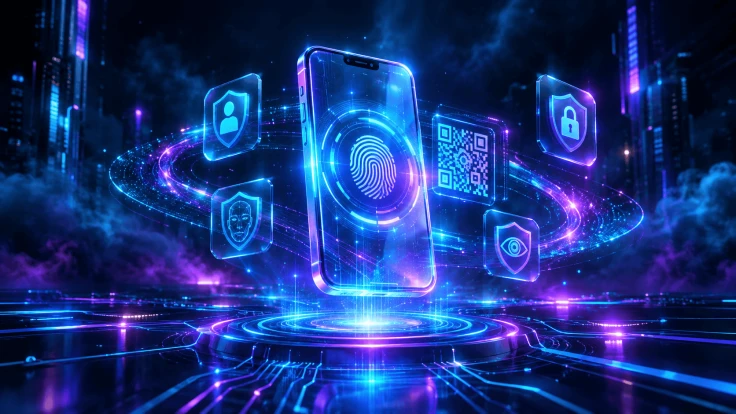
This is where the idea of Digital ID comes in.
The idea behind Digital ID is to create a separate digital identity for your phone before it gets lost or stolen.
Instead of relying only on the IMEI, Digital ID can use multiple hardware and device characteristics together to create a device fingerprint.
These may include things such as:
These signals can then be combined to create an identification fingerprint, and a SHA-256 hash can be generated from the identification data.
A QR certificate can then be created from the information.
The idea is simple.
While you still have your phone, you create its Digital ID once.
You can then save the generated QR code or data somewhere safe, such as:
If your phone is ever lost or stolen and you need to prove its identity, the Digital ID can potentially be used as an additional way to identify the device.
An important point is that hardware-based data is not the same for every phone.
For example, thousands of copies of the same phone model may exist in the market.
Many of them can have the same amount of RAM or the same number of CPU cores.
Therefore, one identical ID cannot be used for every device.
Instead, the goal is to create a unique identity for each individual phone.
Digital ID can assign different weight or significance to different signals.
It can then calculate things such as:
This can help present an ownership claim in a more structured and transparent way.
One of the ideas behind Digital ID is that the identification should not depend entirely on the IMEI.
So even if a phone is restored, flashed, or its IMEI is changed, the Digital ID could potentially provide additional information for identifying the original device.
If someone tries to bypass the identification by replacing a small component, such as the camera module, a percentage-based matching or cross-verification system could potentially compare the remaining characteristics.
For example, if a large portion of the original device fingerprint still matches, it could provide supporting evidence for an ownership claim.
However, this should be treated as supporting evidence, not as automatic legal proof of ownership.
If systems like this become widely used, they could potentially make stolen phones harder to resell or use.
If buyers and sellers can verify a device's identity before a second-hand transaction, it could become harder to sell a stolen device as a normal second-hand phone.
In the long run, better device identification could become one part of a broader system for reducing mobile phone theft and resale.
Another feature being considered is biometric authentication.
This is not mandatory.
If a phone supports fingerprint or another supported biometric authentication method, it could potentially be used as an additional verification factor.
Because biometric information is highly personal, it can provide an additional layer of authentication when properly implemented.
The idea is that the QR certificate can store an authorization reference without exposing the actual biometric information.
This could allow the biometric component to act as an additional verification factor.
You can access the Digital ID application here:
👉 https://digitalid.psychotech.top
The Digital ID application is currently designed as a frontend web application.
The current version is only a frontend web application.
In the future, the plan is to integrate a backend for securely storing device identity information and, where legally and technically appropriate, owner information such as contact details.
Future ideas may also include features related to lost or stolen devices, such as:
Some ideas may require dedicated Android permissions, backend infrastructure, and careful privacy and security design before they can be implemented safely.
Anyone who has ever lost a beloved phone knows how stressful it can be.
That's why it can be useful to prepare before your phone is lost or stolen.
Creating a Digital ID while your phone is still safely in your hands may provide an additional record that could be useful later for device identification and ownership verification.
Hopefully, you will never need it.
But if something does happen, having the information prepared in advance may help.
Best wishes to everyone. Stay safe and take care of your devices. ❤️