
Leave a Review


You can use it as a teacher, a thought partner, a planner, or an assistant to help organize your work. However, simply asking questions like "explain this to me" doesn't always yield the best results.
How you instruct ChatGPT matters significantly. Assigning it a specific role, sharing your goals, and clearly defining the desired outcome usually leads to much more useful responses.
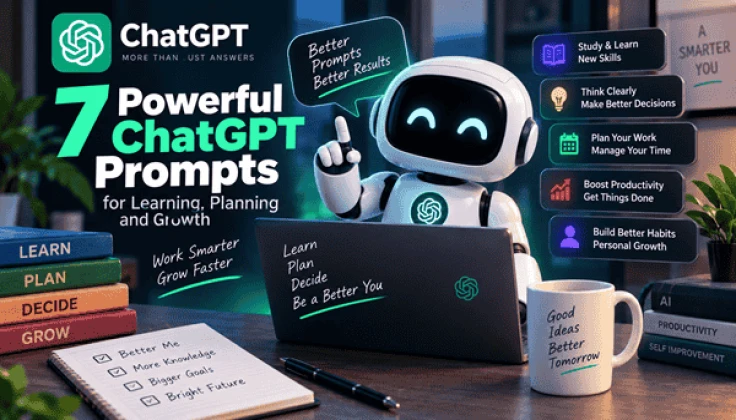
This article presents seven powerful prompts that you can use for studying, learning new skills, decision-making, time management, and personal growth. Real-world examples accompany each prompt so that—beyond just copying and pasting—you understand when and how to use them effectively.
First, let’s clarify one thing.
You often see terms like "secret prompts," "hidden prompts," or claims about "unlocking ChatGPT's special powers with a single prompt" online. In reality, most of these are merely catchy headlines. There is no guarantee that typing a specific phrase will activate some hidden mode within ChatGPT.
However, a well-crafted prompt can indeed make ChatGPT’s responses far more structured and practical. This is because you are proactively defining what you want, your current situation, and how you need ChatGPT to assist you.
We make countless decisions—big and small—every day. Whether it’s deciding where to invest your time, which skill to learn, whether to switch jobs, or whether to start a new project—focusing solely on immediate gains can often lead to mistakes.
The goal of this prompt is to use ChatGPT as a partner in your thought process. The prompt is:
“Act as my thinking coach. Teach me how to think so that I can better understand long-term goals, the interconnections between problems, achieving high impact with minimal effort, the value of opportunities, and critical decisions. When I bring a decision or a problem to you, do not simply provide an answer. Instead, point out the weaknesses in my reasoning, suggest alternative approaches, and explain the potential long-term consequences of a decision. Also, give me a simple thinking exercise every day.”
Suppose you are currently employed and want to learn a new skill online, but you are unsure which skill to prioritize. Instead of simply asking, “Which skill should I learn?”, you can use this prompt by describing your specific situation.
“I am currently employed and have about two hours of free time every night. I want to develop a skill that allows me to earn money online within the next two years. I have three options: web design, video editing, and digital marketing. Please analyze which one would be the most logical choice considering my time constraints and current situation. Don't just name one option; compare the pros, cons, learning duration, and long-term potential of each, and provide a simple framework to help me make a final decision.”
Using it this way, ChatGPT won't just give you an answer; it will also help clarify your decision-making process.
Many of us make a common mistake when learning something new: trying to learn too much at once. One day it’s a video, the next a different course, and the day after, a completely different topic. After a while, we realize we’ve covered a lot of ground but haven't actually mastered any single subject.
You can use ChatGPT as your personal tutor with this prompt.
The prompt is:
“Act as my personal tutor. I want to learn [the subject you want to learn]. My current level of knowledge is [your current status], and I can dedicate [amount of time] daily. Teach me step-by-step, starting from the basics. Incorporate self-testing, periodic reviews of previous material, explanations in simple language, and regular practice sessions. Create a realistic 90-day plan for me, specifying exactly what I will learn and practice each week.”
Suppose you want to learn web design but are a complete beginner. You could write:
“I am a complete beginner and want to learn web design. I can dedicate one hour every night from 9 PM to 10 PM. Within the next 90 days, I want to learn the fundamentals of HTML, CSS, and JavaScript and build at least three small websites. Please provide a weekly learning plan. At the end of each week, give me a short quiz and adjust the following week's practice based on my mistakes.”
The most important aspect here is that you have clearly stated your current situation, available time, and goals. This makes it easier to create a tailored plan for you, rather than just providing a generic learning list.
Learning a skill solely from books is not the same as learning through practical application. To truly master a skill, you need a combination of practice, making mistakes, and doing actual work.
This prompt is designed to turn ChatGPT into an experienced instructor rather than just a source of information.
The prompt is:
"Teach me [your desired skill] as if you were an expert instructor. Assume I am starting from scratch. First, ask me a few questions to assess my current knowledge. Then, outline the learning steps. For each step, explain what I need to learn, what I need to practice, common mistakes to avoid, and how I’ll know when I’m ready to move to the next stage. Don't just teach theory; assign practical tasks at each stage and point out any errors in my work."
Suppose you want to learn writing. You could write:
“Teach me like an experienced Bengali blog writer. I have written before, but I often repeat the same points, and my openings lack engagement. First, conduct a brief test to assess my writing skills. Then, guide me through selecting topics, crafting headlines, writing introductions, organizing information, and practicing a natural writing style. After each exercise, point out my mistakes and suggest ways to improve.”
This approach is highly effective because it doesn't just ask ChatGPT to "teach"; it mandates a complete process: teaching → practice → testing → error correction.
Sometimes, before making a decision, we assume our initial assumptions are correct, only to realize later that the actual problem lay elsewhere. In such situations, viewing your thoughts from an external perspective can be very helpful.
The prompt is:
“Act as a coach for my thought process. My current situation is: [describe your situation]. The decision I want to make is: [state the decision]. Identify any flawed assumptions, biases, emotional influences, or logical weaknesses in my thinking. Do not answer just to please me; point out directly where my reasoning is weak. Then, analyze the issue from at least three different perspectives and suggest questions I should ask myself before making the final decision.”
Suppose you are considering quitting your job to start your own business. You could write:
“I currently have a job with a steady monthly income. Alongside this, I run a small online business that does not yet generate consistent revenue. I want to quit my job and dedicate myself full-time to the business. I have enough savings to cover six months of expenses. Analyze the risks and potential benefits of this decision, as well as the weak points in my reasoning. Do not answer just to encourage me; clearly point out if there are any major risks in my plan.”
For such critical decisions, you should not treat ChatGPT’s response as absolute truth. Instead, it is best used as a helpful tool to evaluate and refine your own thinking.
When trying to organize our lives, we often create overly demanding routines. We plan to wake up at 5 AM, study for hours, exercise regularly, work, and attend to family needs—all at once. However, maintaining such a routine becomes impossible after just a few days.
A good plan isn't necessarily the most difficult one; rather, a good plan is one that can be sustained over the long term.
Here is the prompt:
“Help me organize my life better. My current lifestyle is: [describe your situation]. My main goal is: [state your goal]. I have approximately [amount of time] available each day. Create a simple daily schedule that strikes a realistic balance between work, family, rest, learning, and personal time. Do not suggest a routine that is difficult to maintain in the long run. First, identify my current challenges, then create a 30-day plan based on small, incremental changes.”
Suppose you manage your own website alongside your job.
“I work from 9 AM to 6 PM. It takes about an hour to get home. I want to work on my website at night but struggle to find the time consistently. I can dedicate a maximum of two hours a day to this personal work. Create a realistic daily and weekly routine for me that balances my job, rest, and the website. Also, advise me on which tasks I should eliminate or cut back on.”
In this instance, you aren't just asking ChatGPT to create a routine; you are also asking for advice on what to eliminate. Often, this is the most crucial aspect of time management.
There are only 24 hours in a day. Therefore, prioritizing important tasks is far more effective than simply trying to do more work. The purpose of this prompt is to break down your major goal into smaller, manageable tasks and identify areas where technology can assist.
The prompt is:
“Act as my work planner. My primary goal is: [insert goal]. I want to make as much tangible progress toward this goal as possible over the next year. My current time availability, skills, budget, and constraints are: [insert details]. Analyze my tasks and identify which ones will yield the best results, which are less critical, which can be simplified using technology, which can be delegated to others, and which can be eliminated. Then, create a 12-month plan and highlight the most important tasks for each month.”
Suppose you have a small blog and want to bring it to a stage where it generates regular income within the next year.
“I have a Bengali blog. I handle everything—writing, creating images, updating old posts, and managing social media—on my own. I can dedicate about two hours a day to this. Over the next year, I want to improve the website's quality and grow my readership. Please prioritize my tasks. Indicate which tasks should be done first, which later, and which can be expedited using AI or other simple technologies. Provide a month-by-month plan.”
Note that this prompt doesn't just ask for "ways to work faster." It also addresses the question of which tasks are essential and which can be skipped—a crucial factor in saving time.
When planning to transform ourselves, we often set overly ambitious goals. However, significant change rarely happens overnight. Consistently performing small, daily actions over a long period can have a profound impact. The prompt is:
“Act as my personal development coach. Over the next year, I want to become [describe the person you want to be]. My current habits, strengths, weaknesses, and time constraints are: [describe your situation]. Based on my goal, determine which habits I need to build, which ones I need to cut back on, and what small daily actions I should take. Provide a simple 30-day plan to get started. Also, include a few questions at the end of each week to help me track my progress.”
Suppose you want to read more consistently:
“I want to become a more knowledgeable and consistent person over the next year. My biggest challenge is that, despite wanting to read, I fail to stick to the routine after a few days. I can only spare 20 minutes a day for reading. Create a 30-day plan for me that starts with very small habits. Clearly explain what I should do each day, when to do it, and how to get back on track if I miss a day.”
A major advantage of this type of prompt is that it steers you toward small, actionable steps rather than overwhelming, unrealistic changes.
If the response you get after sending the prompt to ChatGPT seems too generic, don’t be discouraged. Instead, provide more specific details in a follow-up prompt.
For instance, after the initial response, you could say:
“I only have 30 minutes a day. Please scale down the plan accordingly.”
“My budget is very tight. Suggest free methods first.”
“The plan is too complex. Simplify it for a busy person.”
“Identify my weak points first.”
“Provide more details for the tasks in the first 7 days.”
“Don’t give me everything at once. Provide the next step only after I finish the current one.”
By maintaining a dialogue like this, you can use ChatGPT as an assistant rather than just a one-off Q&A tool.
Not every prompt needs to be long. However, the more clearly you articulate your needs, the better the results are likely to be. You can include the following details as needed:
Your goal: What do you ultimately want to achieve?
Current status: What stage are you at right now?
Time: How much time can you dedicate daily or weekly?
Constraints: Are there any issues regarding budget, time, skills, or other factors?
Preferences: What kind of plan or explanation do you prefer?
Outcome: What exactly do you want from ChatGPT?
No. It is better to start with just one based on your needs.
For instance, if you want to learn a new skill, you could start by using the second prompt to create a 90-day plan. Later, while learning, you could use the third prompt for hands-on practice. If you face a major decision, you might use the fourth prompt.
Similarly, the sixth prompt would be useful if you have time constraints, while the fifth prompt could help organize your daily life.
Many people collect hundreds of prompts from the internet but stop using them after a few days. In reality, repeatedly using 5–7 effective prompts tailored to your needs is far more beneficial than memorizing a hundred of them.
Another point to consider is that there is no guarantee ChatGPT’s answers will always be accurate. Especially when receiving answers regarding information, research, finance, law, medicine, or other critical topics, verify the details using reliable sources if necessary.
AI can accelerate your work, but it is not meant to make every decision for you or replace real-world experience. You will achieve the best results by combining AI's assistance with your own judgment.
You do not need secret formulas or illicit tricks to make the most of ChatGPT. What truly matters is knowing what you want and how clearly you can convey that to the AI.
These seven prompts were designed with that in mind. By using them, you can leverage ChatGPT for more than just getting answers—you can use it to create learning plans, validate your ideas, organize your time, and build consistent habits.
However, for the best results, do not simply copy and paste the prompts verbatim. Incorporate details about your specific situation, timeframe, goals, and constraints. If the initial response isn't quite what you wanted, instruct the AI to make it simpler, more specific, or more realistic.
Visit LekhokBD.me for the latest tips.
Ultimately, the secret to success lies not in some "secret mode." A clear objective, precise instructions, and the habit of consistent use are what truly transform ChatGPT into an effective assistant.