



Leave a Review
Do We Really Use Only 10% of Our Brain? Science Debunks the Myth
27 Oct 2026 • 6 min read • 50 views •
Share:

Do We Really Use Only 10% of Our Brain? Science Debunks the Myth

A
AroraShop
Content Writer

Do We Really Use Only 10% of Our Brain? Science Debunks the Myth

Have you ever heard the fascinating claim that human beings only use 10% of their brains, while the remaining 90% lies completely dormant and untapped?

This idea is remarkably widespread. It has been repeated in blockbuster sci-fi movies (such as Lucy and Limitless), self-help bestsellers, motivational keynotes, and viral social media posts. The enticing premise suggests that if we could somehow unlock that "hidden 90%", we could instantly acquire superhuman intellect, telekinetic powers, or flawless eidetic memory.

But does modern science support this tantalizing concept? The definitive answer from contemporary neuroscience is an absolute NO. The belief that humans use only 10% of their brain capacity is one of the most thoroughly debunked myths in medical history.

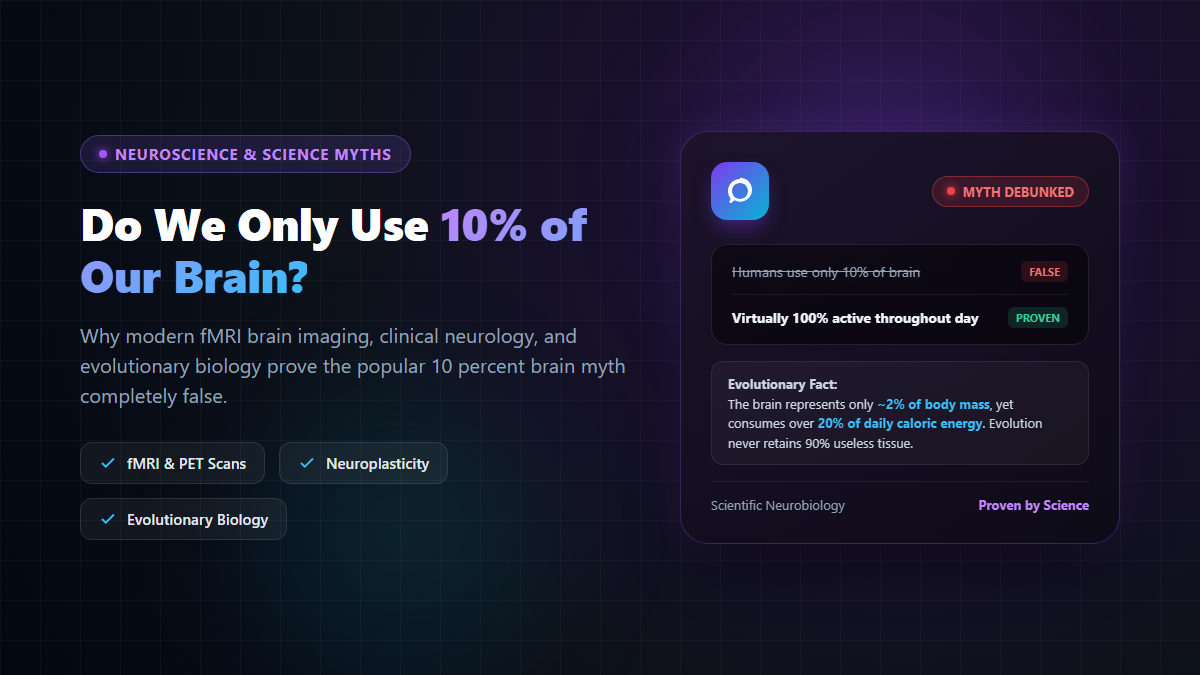
Do we only use 10 percent of our brain myth debunked banner
Modern brain imaging and clinical neuroscience prove that virtually 100% of the human brain is active and essential.

Quick Summary: Key Scientific Facts

  • The Verdict: The 10% brain myth is completely false. Humans use virtually 100% of their brain tissue over the course of a normal day.
  • Evolutionary Proof: The brain accounts for only ~2% of our total body mass, yet consumes over 20% of our daily oxygen and caloric energy. Natural selection would never preserve a 90% useless organ.
  • Clinical Evidence: Neurologists know that minor damage to even tiny, specific brain regions (from a stroke or concussion) produces noticeable cognitive or motor deficits. If 90% were unused, 90% of brain injuries would be harmless.
  • Real Cognitive Growth: Humans enhance intelligence and memory through Neuroplasticity (strengthening synaptic pathways through deliberate learning, adequate sleep, and exercise) — not by flipping an imaginary 90% switch.

Where Did the 10% Brain Myth Originate?

While there is no single peer-reviewed scientific paper that ever claimed this, historical misinterpretations over the last century fueled the rumor:

  1. Glial Cell to Neuron Ratios: Early neuroanatomists discovered that neurons make up only about 10% of brain cells, while support cells known as glia (which insulate, nourish, and protect neurons) make up the remaining 90%. Misinformed journalists misunderstood this structural ratio as meaning only 10% of the brain was "functioning".
  2. Misquoted Philosophers & Psychologists: In the early 1900s, legendary psychologist William James wrote that human beings only make use of a small part of their mental potential. Popular writers later distorted this philosophical observation into a literal biological statistic.
  3. Hollywood Sci-Fi Appeal: Screenwriters love the trope because it provides an effortless storytelling shortcut to give characters psychic or superhero capabilities.

How Much of Our Brain Do We Actually Use?

The short answer: Almost all of it.

Just because your entire brain is not firing at maximum voltage simultaneously does not mean any portion is inactive or unnecessary. Think of your brain like a bustling city or your home's electrical grid. You do not turn on every electrical appliance — the microwave, air conditioner, lawnmower, oven, and blender — at the exact same second, because that would blow a fuse. Similarly, your brain dynamically coordinates specialized regional networks depending on your current task:

  • When you read an article: Your visual cortex interprets shapes, Wernicke's and Broca's areas decode language syntax, the prefrontal cortex maintains focus, and the hippocampus retrieves context from long-term memory.
  • When you walk down the street: The motor cortex commands muscles, the cerebellum continuously balances equilibrium, and sensory regions map spatial awareness.
  • Even when you are sound asleep: The brain never shuts down. During sleep, your brain consolidates memories, prunes obsolete neural connections, flushes metabolic waste toxins through the glymphatic system, and generates dreams.

What Modern Neuroscience Proves

Modern medical diagnostic instruments have provided conclusive evidence that exposes the 10% myth:

1. Functional Magnetic Resonance Imaging (fMRI)

fMRI technology tracks localized changes in blood flow and oxygenation in real time. Brain scans consistently reveal that even simple cognitive activities light up interconnected neural networks across both hemispheres. There is no large, silent, dark area of the brain sitting abandoned.

2. Positron Emission Tomography (PET Scans)

PET scans map metabolic glucose consumption throughout the central nervous system. These scans demonstrate that every region of the brain exhibits continuous, active baseline metabolism around the clock.

3. Clinical Lesion & Stroke Studies

In clinical neurology, if 90% of the brain were truly unused, people who suffer strokes, head trauma, or surgical tumor resections in those dormant areas would experience zero functional loss. In reality, damage to virtually any specific millimeter of brain tissue produces noticeable consequences — ranging from speech impairment (aphasia) to paralysis or memory degradation.

Can We Become "Superhuman" by Unlocking the Rest?

No. There is no dormant 90% switch waiting to be flipped.

However, that does not mean human cognitive capacity is fixed in stone. The human brain possesses an extraordinary biological capability known as Neuroplasticity.

Understanding Neuroplasticity

Neuroplasticity is the brain's structural ability to reorganize itself by forming new neural pathways and strengthening existing synapses throughout your lifetime in response to learning, practice, and sensory experience.

When you practice a musical instrument, master a programming language, or memorize chess openings, your brain physically reshapes its neural architecture. Experienced musicians have enlarged sensory-motor cortex regions, and London taxi drivers who memorize complex street navigation show measurably larger posterior hippocampi.

Evidence-Based Ways to Maximize Brain Function

Instead of chasing fictitious 90% shortcuts, neuroscientists recommend four proven habits to optimize cognitive performance:

  1. Get 7 to 8 Hours of Quality Sleep: Sleep is when the brain consolidates short-term memories into stable long-term storage and flushes harmful amyloid-beta proteins.
  2. Engage in Regular Aerobic Exercise: Physical cardiovascular exercise boosts cerebral blood circulation and stimulates brain-derived neurotrophic factor (BDNF), which spurs new synaptic connections.
  3. Continuous Lifelong Learning: Challenging your mind with complex problem-solving, reading, languages, or strategic games builds robust cognitive reserve that protects against age-related cognitive decline.
  4. Maintain a Nutrient-Rich Diet & Hydration: Nourishing your brain with omega-3 fatty acids, antioxidants, and adequate water ensures smooth neurotransmitter signaling.

Conclusion: Appreciating the Brain You Already Have

The myth that you only use 10% of your brain might make for an entertaining Hollywood movie script, but biology tells a far more awe-inspiring story.

You already use 100% of your brain. It is the most sophisticated, energy-dense computing machine known in the universe. Rather than daydreaming about unlocking imaginary dormant sectors, focus on nourishing, challenging, and protecting the extraordinary mind you already possess.

Support
Customer Support
We typically reply in minutes

Please login to live chat or contact via WhatsApp
Open WhatsApp Chat on WhatsApp
OR